Sealing Shafts Experiencing Significant Motion
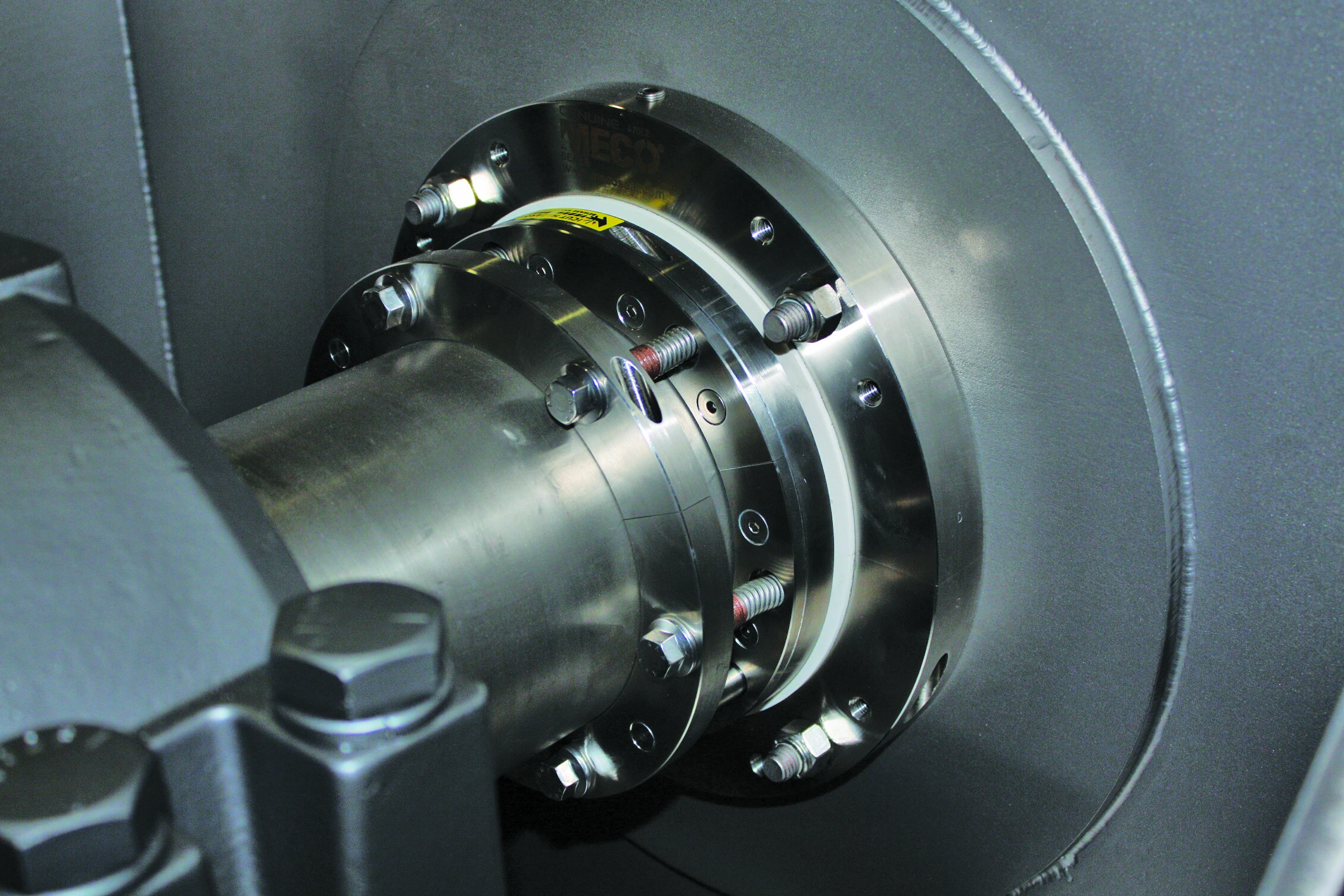
The MECO OFS Type-1 seal is a fully-split seal for vacuum, low pressure, fluid, vapor, and abrasive applications. The design tolerates both runout and thermal growth at moderate speeds, maintaining seal face contact without the need for a barrier fluid. The seal places a single, stainless-steel rotary seal face, spring-loaded against a single, bearing-grade, polymeric stationary seal face. A wide selection of sizes and materials are available, allowing service in diverse processes.
- Fully split
- Easily cleaned
- Air-free
- Self-adjusting
OFS Type-1
Details
Description
The MECO OFS Type-1 split seal is ideal for top-entry agitators, crystallizers, dryers, pan mixers, blenders, hoppers and similar rotating equipment used in the petrochemical, plastics, metals, minerals and other process industries. This seal is appropriate for top-entry and horizontal shafts, and has been implemented in applications ranging from cryogenic temperature environments to relatively hot steam saturated conditions under full vacuum. Keeping process materials inside the vessel and preventing atmospheric oxygen from entering the process, the OFS Type-1 is used in the production of plastic resins and additives, paraxylene, solvent-based inks, VOC vapors and fumes, crystal sugar, industrial chemicals, industrial fermentation processes, as well as hot food cooking and drying applications.
Process improvements encompass product and atmosphere containment, product purity, batch time reduction and consistency between batches, extended mean-time-to-repair (MTR), and only two to four hours of installation time once the equipment is prepared.
How it works
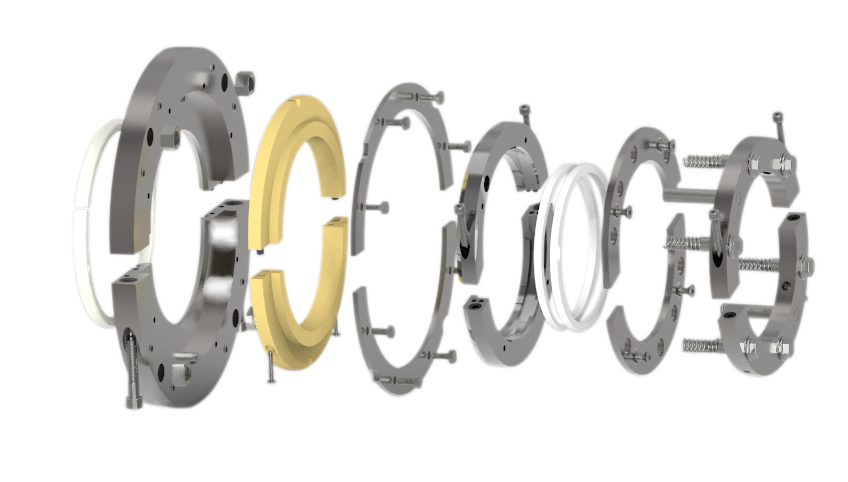
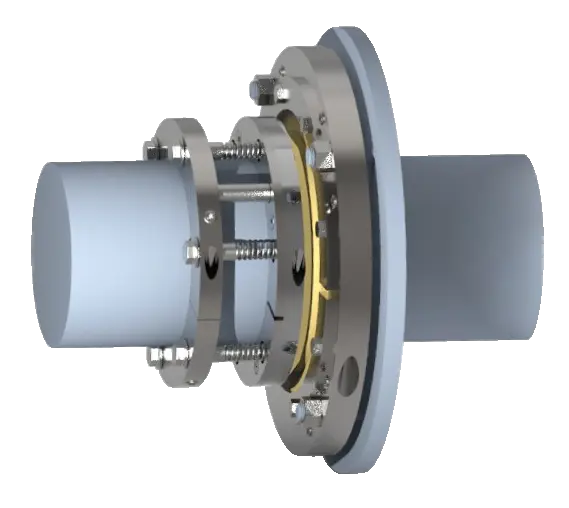
Without using a gas purge, the OFS Type-1 seal replaces stuffing boxes, lip seal housings, hard-face mechanical seals, elastomer-driven seals, and unsplit seals. The split seal housing is fitted to your equipment, complete with a split, bearing-grade, synthetic stationary seal face. The rotary seal face is made from stainless steel positioned at a right angle to the shaft and is maintained in contact with the stationary seal face via external load springs and actuators. Sealing along the shaft is accomplished with a static ring of braided packing or an “O”-ring, contained within the inner diameter of the rotating seal face. The rotary seal face is turned by drive pins, fixed to a drive collar which is locked to the shaft. The seal designer predetermines the spring calibration, based on application parameters.
Maintenance
Although the external parts of the MECO OFS Type-1 split seal are easily viewed for a quick visual inspection, when installed on top of a 30-foot agitator or behind a shroud, they become out-of-sight, out-of-mind and can be forgotten. As such, the seal rarely receives preventative maintenance, but continues performing as intended.
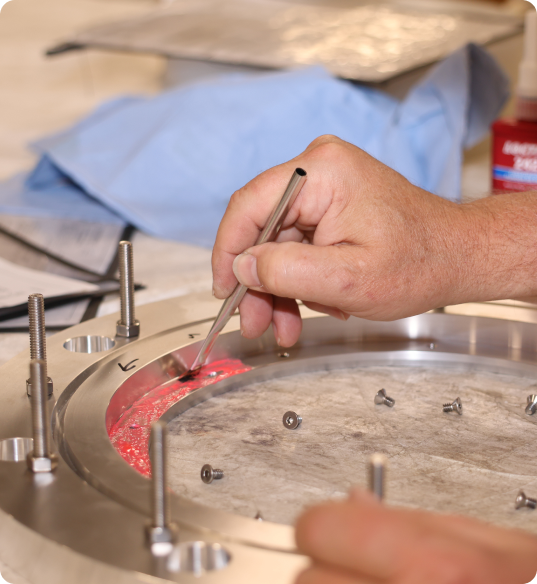
However, to maximize the mean-time-to-repair (MTR), the seal is easily disassembled for inspection, cleaning, and resetting, as well as replacement of any exposed “O”-rings or packing. By loosening the spring actuators and releasing the drive collar, the parts may be pulled back for inspection and resetting. Reassembly sets the seal face closing force to original values, accounting for any seal face wear and resetting the seal to a slower wear rate, maximizing the MTR.
Construction
The OFS Type-1 seal components are designed fully-split and to install within your spatial constraints, following MECO’s standards of seamless fit and finish. The design utilizes a stainless-steel rotary seal face, paired with the stationary seal face selected from one of MECO’s bearing-grade polymer blends. The seal’s housing may be fabricated from either aluminum or stainless steel, while drive assemblies are entirely stainless. Depending on the application, the static seal component in contact with the shaft may be made of a braided packing or an elastomeric material. We have several materials available to match the needs of your application, depending on chemical compatibility and temperature characteristics.
Additional seal features may be considered to maximize MTR, such as steady bearings to reduce shaft runout, barrier rings or gas blankets behind the seal housing to further isolate the process from the atmosphere, and porting through the front of the stationary seal face to monitor process pressure trends.
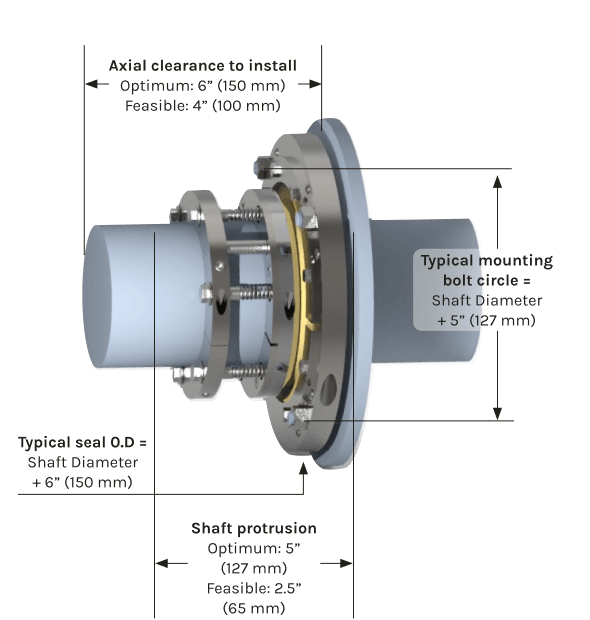
Sizing Chart
Dimensions will vary according to each application, but typical spatial dimensions with respect to the shaft diameter are illustrated in the chart below. Seals are not forced to fit your equipment, but designed specifically for your equipment.
Documentation
Need More Information or a Custom Quote?
Our team is ready to assist you with any questions or provide a personalized quote for your seal needs.
Get in touch